What Happens After Witchcraft Stops Being Aesthetic?
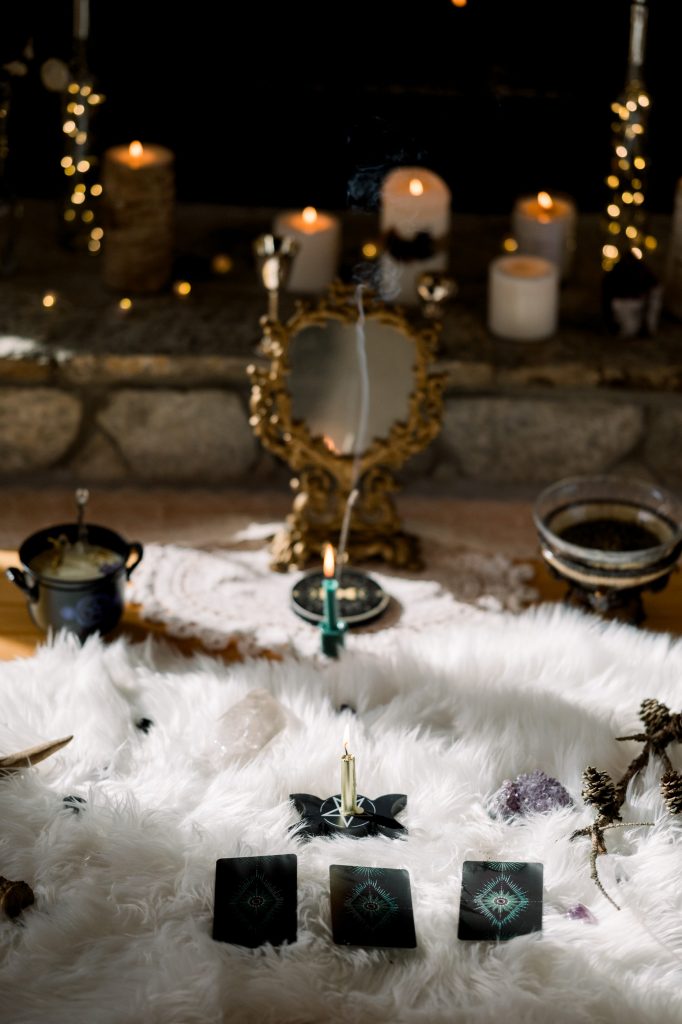
There is a version of witchcraft, as it is often shown to us through social media, that lives almost entirely in the image: the candles, the altar, the herbs in glass jars, the black clothing, the moon rituals, the books stacked just so, the sense of mystery arranged beautifully enough to be seen.
And there has been meaningful conversation about this, about witchtok, witchcore, aesthetic witchcraft, and the question of what, exactly, we are looking at when spirituality becomes highly visual, highly curated, and highly performative online. I think that conversation matters.
Because that version of witchcraft is not nothing. It should not simply be dismissed as superficial or meaningless. Aesthetic has a real place. Beauty has a real place. The environments we create around ourselves shape our nervous system states, our receptivity, our sense of safety, our access to symbolism, reverence, and inner experience. Aesthetic can be a valid way of creating intentional states of being.
But it can also become spiritually confusing when it gives the false impression that being inside the aesthetic is the same thing as inhabiting the life.
That, to me, is where the deeper conversation begins.
Aesthetic Has A Place
The aesthetic dimension of spiritual life is real. It is not decorative fluff. It is not irrelevant. Human beings are shaped by environment, and we know this psychologically, somatically, and spiritually. Light, texture, color, order, symbol, scent, sound, rhythm, all of these affect our inner world. They can calm the nervous system. They can open receptivity. They can create a sense of safety, readiness, beauty, and reverence. They can help shift us out of the defended, over-mentalized, disenchanted state so many of us are trained to live in.
A beautiful altar can matter. A candle can matter. A room shaped with intention can matter. Ritual objects, symbols, fabrics, herbs, moonlight, atmosphere, these things can all help create conditions in which the psyche softens, the body becomes more available, and the soul becomes more reachable. In that sense, aesthetic is not nothing. It can be meaningful. It can be potent. It can be part of how we create intentional states of being.
For many women, this is exactly how the path begins. The aesthetic is the first thing that stirs something ancient. It is the first crack in the hard shell of a flat, over-rational, disenchanted world. It is the first signal that there may be more to life than productivity, performance, exhaustion, and survival. It gives shape to longing before longing even has language for itself.
Sometimes the aesthetic is the first yes. Sometimes it is the first remembering. Sometimes it is the first threshold.
And that matters.
What Do We Mean By Threshold?
If we are going to use that word, we should define it.
A threshold is a point of passage. It is not the destination itself, but the place where movement becomes possible. It is the place between one state and another, one mode of being and another. It marks transition. It implies that something is ending, something is beginning, and that crossing requires participation.
Spiritually, a threshold is the place where transformation becomes available because you are no longer fully inside your old orientation, but you are not yet fully inhabiting the new one either. It is an initiatory place. It asks attention. It asks willingness. It asks some form of consent. It asks that you do more than admire what is possible. It asks that you begin to enter it.
That is why threshold is such an important word here. Because the aesthetic can absolutely function as threshold. Beauty can invite. Symbol can awaken. Atmosphere can call something forward in us. But threshold is not arrival. Threshold is the beginning of passage.
And this is part of the problem with social media aesthetics: they do not announce themselves as threshold. They often present themselves as destination. They look complete in themselves. They look like the thing itself rather than an invitation into the thing.
That is where the obstruction begins.
The Danger Is Not Aesthetic Itself
Let me be very clear: the real danger lies in mistaking aesthetic participation for lived spiritual reality.
Not beauty. Not symbolism. Not pleasure. Not reverence expressed through image.
The problem is when the atmosphere of spirituality gets mistaken for spirituality itself. When curation gets mistaken for practice. When visual participation gets mistaken for embodiment. When proximity to the symbols of a life begins to feel like the life itself.
And in an online world, that confusion becomes very easy. Social media is built around the visible. It privileges what can be shown, arranged, framed, stylized, and circulated. It makes spirituality appear from the outside in. The setup becomes legible. The mood becomes legible. The objects become legible. The image becomes legible. But the deeper life underneath it, the devotion, the honesty, the discipline, the ethical work, the grief work, the embodiment, the surrender, the long slow transformations, those are far less visible.
So the image can begin to stand in for the reality. And when that happens, a person can start to feel that if she is in the aesthetic, then she is in the life.
That is where a more spiritually mature assessment becomes necessary.
Where The Distortion Begins
The problem is not that people encounter the path through beauty. The problem begins when the atmosphere of transformation becomes a place someone lingers indefinitely rather than passes through, when the image of mystery becomes more compelling than the demands of mystery, when setup, curation, projection, and broadcast become their own closed loop.
This is what happens when threshold becomes habitat.
At that point, the altar can become a set. The ritual can become content. The symbol can become branding. What began as invitation starts becoming identity performance.
And again, this does not mean the image is false in every case. It means the image can become severed from depth and begin to substitute for it.
A threshold is meant to be crossed, not inhabited.
If nothing in your life is being asked to shift, if your spirituality is not asking for greater honesty, greater embodiment, greater responsibility, greater devotion, greater discernment, then you may still be standing in the doorway mistaking proximity for passage.
The Question Underneath All Of This
This also raises a deeper question, one I think matters a great deal right now.
If your witchcraft is not being presented on social media, is it still valid to you?
If no one sees your altar, your ritual, your prayer, your practice, your devotion, your lifestyle, is it still real? If it is not externally witnessed, aesthetically translated, or affirmed through an outside gaze, does it still count?
That is not a small question. It may be one of the defining spiritual questions of this era.
Because real spiritual life has always contained vast invisible dimensions. The prayer no one hears. The ritual no one witnesses. The vow no one applauds. The private act of devotion. The daily tending. The integrity of how you live when nothing about it is being framed for someone else’s consumption.
If those things do not feel valid unless they are externally seen, then what is being formed is not spiritual life, but a performative practice built around external validation from the masses.
That is not freedom. And it is not maturity.
The Consumer Distortion
There is another layer here that has to be named plainly: capitalism is extraordinarily skilled at swallowing sacred impulses and turning them into products.
It knows how to package longing. It knows how to monetize atmosphere. It knows how to sell identity through objects, aesthetics, and symbolic worlds. And aesthetic witchcraft is especially vulnerable to this because it is so visually potent.
The market can sell candles, decks, robes, crystals, altar cloths, moon planners, herb bundles, ritual kits, identity markers, and the entire curated grammar of enchantment. It can sell the feeling of depth. It can sell the appearance of power. It can sell the outer costume of mystery while leaving the deeper work untouched.
You can buy the image of enchantment much faster than you can become someone capable of living in right relationship with mystery.
That does not mean beautiful tools are bad. It does not mean objects cannot matter. But when acquisition replaces apprenticeship, something has gone sideways. When display replaces discipline, something has gone sideways. When consumption begins to stand in for consecration, something has gone sideways.
And social media intensifies all of this because it rewards what looks potent, not necessarily what is patient. It rewards what photographs well, not necessarily what transforms a life.
The Feminist Layer Underneath It
There is also a specifically feminist dimension to this conversation.
Patriarchal culture trains women to become fluent in being seen, to understand themselves through appearance, legibility, desirability, and the management of image. Even rebellion can get aestheticized and folded back into that structure.
So when witchcraft becomes primarily aesthetic, women can end up reproducing the same old pattern under a more mystical banner. Archetype becomes costume. Mystery becomes branding. Power becomes something signaled rather than embodied. Wildness becomes stylization.
A woman may feel she has stepped outside the patriarchal frame because the imagery is darker, older, more feminine, more symbolic, more transgressive. But if the center of gravity is still external, still organized around appearance, projection, and symbolic performance, then the deeper structure has not actually changed. It has simply put on different clothes.
There is a difference between embodying power and styling yourself in its symbols.
That difference matters.
Because patriarchal culture is often more comfortable with women performing power than with women becoming difficult to manipulate, difficult to seduce away from themselves, difficult to govern through approval and image. Real power changes how you live. It changes your standards, your boundaries, your self-trust, your relationship to your body, your desire, your time, your labor, your voice, and your values.
That kind of power cannot be reduced to a look.
When Life Asks Something Real
Sooner or later, every spiritual path is tested by life, not by whether it photographs beautifully, but by whether it can hold you when things begin to fall apart.
Grief does this. Illness does this. Heartbreak does this. Burnout does this. Disillusionment does this. Real longing does this too, the kind that is no longer satisfied by looking connected to mystery, but wants to actually be changed by it.
There comes a moment when the question stops being, How do I create the feeling of sacredness around my life? and becomes, Can this path teach me how to live?
Can it deepen me? Can it strip illusion? Can it call me into truth? Can it make me more honest? More humble? More whole? More able to love?
When life asks something real of you, aesthetic spirituality stops being enough.
And that is not failure. That is the beginning of maturity.
What Remains After The Aesthetic Falls Away
When the aesthetic falls away, what remains is the actual path: relationship, practice, discernment, ethics, devotion, embodiment.
It becomes relationship with your body, not as a prop or a project, but as a site of wisdom, sensation, memory, and truth. It becomes relationship with season, land, consequence, grief, desire, the unseen, and realities larger than your personal brand. It becomes practice, which is not mood or identity or occasional performance, but the repeated act of showing up, listening, tending, telling the truth, and making your life more congruent with what you claim to revere.
It becomes discernment, which is one of the least glamorous and most essential dimensions of spiritual life. Discernment is learning the difference between intuition and projection, desire and fantasy, ritual and avoidance, symbolism and substance. It is learning how not to be seduced by your own self-image.
It becomes ethics. Magic is not separate from how you live. You do not get to build a gorgeous altar and then live in disrepair with yourself, with others, with truth, with responsibility, and imagine that your practice remains untouched by that.
And it becomes devotion. Not the dramatic kind. Not the public kind. The real kind. The kind that remains when nobody is watching. The kind that appears in how you speak, how you rest, how you nourish yourself, how you keep your word, how you repair, how you refuse what degrades you, and how you tend what is holy in ordinary life.
This is where witchcraft stops being primarily aesthetic and starts becoming transformational. Not because beauty disappears, but because beauty is no longer being asked to do all the heavy lifting.
When The Path Enters The Body
If the path deepens, it eventually enters the body.
This is where a lot of people either mature or retreat, because embodiment is not nearly as easy to curate as atmosphere. Embodiment asks you to feel, to inhabit, to listen, to slow down enough to register what is true. It asks you to learn your own rhythms, tend your nervous system, pay attention to how your body speaks, honor desire as information, honor grief as initiation, and let ritual touch daily life instead of remaining an occasional performance of sacredness.
This is the work of lived spirituality. Not merely believing something. Not merely displaying something. Not merely arranging something beautiful around yourself. But allowing practice to become somatic, ethical, relational, and real.
The real altar is not only the one you build with objects. It is the one that becomes your internal, embodied terrain. It is the life you build with your choices, your practices, your integrity, and the way you inhabit yourself when no one is watching.
The Grief And The Beauty Of Growing Up
There is grief here too, and I think that needs to be said plainly. Because when the aesthetic falls away, something does get lost: the immediacy of the fantasy, the specialness of the image, the comfort of appearing connected without yet being deeply changed, the clean certainty of who you imagine yourself to be.
There is a kind of innocence that ends when you move from image into reality.
But what replaces it is deeper. More demanding, yes. But also more textured, more honest, more rooted, more intimate, more alive.
And in many ways more beautiful, because now the beauty is not just arranged around emptiness. Now it is the outer poetry of something inwardly lived.
The candles can still matter. The altar can still matter. The fabrics, colors, symbols, tools, herbs, and moonlit atmosphere can still matter. But now they are expression, not substitute. Vessel, not performance. Symbol, not simulation. Overflow, not facade.
That is a very different thing.
Beyond The Image
So what happens after witchcraft stops being aesthetic?
If you let it, it becomes a school of spiritual maturity. It teaches you that beauty can call you, but beauty cannot walk for you. It teaches you that symbols matter, but they are meant to point beyond themselves. It teaches you that consumer culture can mimic sacredness without ever delivering depth. It teaches you that patriarchal conditioning can survive inside spiritual image-making if you do not consciously outgrow it. It teaches you that devotion is quieter than performance and stronger than branding. It teaches you that embodiment is deeper than appearance. It teaches you that real practice is not about looking mystical, but about becoming more honest, more relational, more ethical, more discerning, more alive, and more capable of holding power cleanly.
And maybe most of all, it teaches you that a threshold is meant to be crossed, not inhabited.
The aesthetic may be what called you. Thank the mother for that. Many of us needed beauty to remember there was more. Many of us needed symbols to find language for longing. Many of us needed the image before we could imagine the life.
But the invitation was never meant to end there.
What happens after witchcraft stops being aesthetic is that it finally begins to change your life.
School Of Holy Witchery
Come join us in learning about embodying a rich and meaningful life as a Holy Witch, where magic is a gorgeous part of the language and manifestation is an invitation to be a part of a more connected and celebratory expression of life.